NBA tanking has a solution, but the NBA might not want that solution.
It’s been forty years of tinkering with lottery odds as fans regularly give up on seasons and stop watching their teams while they lose on purpose just to gain 2% in a lottery. The incentives tell the teams to do this, so it’s no surprise that they do. Losing to win is completely absurd, but it has become so commonplace that we don’t even blink at it anymore. We just turn off the game.
Years ago, two Stanford researchers proved that it is impossible to both reward the worst teams in the draft and eliminate tanking incentives by just looking at end-of-season records. The NBA promises to fix tanking for real this time, but every draft reform idea they have proposed is swimming in the same paradigm as the impossibility result.
There is a solution.
The solution to the problem, called Carry-Over Lottery Allocation (COLA), is different. It circumvents the impossibility by looking at playoff track record instead of regular-season standings. Where other draft reform ideas navigate a tradeoff, COLA uses a paradigm shift to eliminate tanking while still helping the weakest teams.
It brings another advantage as well. It provides a predictable rebuild “ramp” for teams. A non-playoff team will tend to get better draft picks year over year until they either get a top draft pick or have some measure of playoff success, whichever comes first.
If there is a solution, why wouldn’t the NBA want to use it?
The primary reason appears to be inertia. In order to solve the tanking problem, COLA breaks the current paradigm. Adam Silver said he is an incrementalist, but the tanking problem is unsolvable with just shifting lottery probabilities. A paradigm shift seems like a major change, which could be an issue, but the NBA wouldn’t mind as long as fans and media could understand what’s going on. If there were many people calling for COLA’s use, that would be evidence that it is not too complex. The NBA wouldn’t want to use a paradigm-breaking solution without a popular call to use it. They vote on draft reform at the end of May.
There is no popular call to use COLA because of a misconception about its complexity. Although COLA is easy to use, it can take a deep dive to be convinced that it actually solves the problem. Without a deep dive, COLA may seem like just one among a thousand other proposals on the surface. With a deep dive, it can seem complex. Not because it’s complex to use, but because it’s complex to see what makes it unique. As a result, there are people who have heard of COLA but don’t see why it’s different. There are others who see why it’s different but think it’s too complex to be practical.
My goal right now is to convince you that it’s not too complex to use.
HOW IT WORKS
COLA is a framework with many variants. Here we will discuss the Capped COLA variant. This is how it works.:
A stockpile with adjustments:
Each team has a stockpile of lottery tickets that carries over year-to-year.
Stockpiles of the top 6 playoff seeds in each conference do not grow. For any other team, its stockpile grows at the end of the season by the number of wins the team has, but it cannot grow beyond 150 tickets.
A team’s stockpile is reduced by some amount based on playoff success and if they win a top lottery pick.
The lottery:
The top 5 picks are raffled off in the usual way. Draft picks 6+ are ordered by largest stockpile.
Eligibility:
Teams that won a top-5 lottery pick last year do not enter the lottery.
Teams that won a playoff series this year or last year do not enter the lottery.
A team that is lottery-eligible enters their whole stockpile of tickets, but then the stockpile carries over to the next year (possibly after a reduction if they won a top pick).
Read that description again. It takes less than two minutes to read it twice and understand how the system works.
There are more implementation details covered below (e.g. the schedule for reducing the stockpile), and we have not touched on the question of why it works. But it’s not too complicated to implement if it took two minutes to understand the basics: every team has a stockpile of tickets that grows and shrinks over time, and that is what determines a team’s draft priority.
The claim is that there’s no tanking under COLA, and the weakest teams get the most help from the draft. There’s an academic paper with a proof submitted for peer review, Ric Bucher and Nick Elam (inventor of the Elam Ending) gave positive comments on the idea, and there’s a Philadelphia Inquirer article on the proposal coming out soon. If that’s enough for you, then maybe you just want to trust that the claim holds up.
Would you want this proposal to be implemented? It won’t be without momentum. The vote is at the end of May. This is a paradigm shift, so it will require broad support to convince the NBA to move this direction. This feels like the twentieth article I’ve written saying the same thing. (Honestly, it might be the fifth.) It’s a baffling feeling to hear the whole world complain about a problem, to have the solution, and feel ignored. I’ve had serious conversations with people in the NBA front offices, been on several podcasts, and watched a reddit thread on COLA get thousands of upvotes. But then the conversation moves on as if nothing happened. I’ve been ghosted by more media than I care to count. If you see what makes COLA different, do something to build momentum.
Edit:
Following the advice of Tracy Friedlander, let’s make the request more specific. Please share this post to two people who know what the NBA is
but don’t know what COLA is.
As of today, that might be 99% of people who follow the NBA.
On the other hand, if you aren’t someone who wants to simply trust that the claims hold water, the rest of this article is for you.
UNDER THE HOOD
I would ask you to pause now and consider that what we’ve said so far is enough to understand how the system works. For a full implementation, there are some more details of Capped COLA that need to be fleshed out. For a full understanding of the incentive structure built into COLA, we need to cover a lot more ground. However, the full details and the justification are not required to follow the lottery and draft.
First, let’s finish the details for Capped COLA. The schedule for stockpile reduction is as follows:
The winners of the 1st, 2nd, 3rd, 4th, and 5th draft picks have their stockpiles reduced by 100%, 80%, 60%, 40%, and 20%, respectively.
Stockpiles of teams that make the play-in but lose in the first round are reduced by 10%
Stockpiles of other teams that lose in the first round are reduced by 20%.
Stockpiles are reduced by 40%, 60%, 80%, and 100% for the teams that win 1, 2, 3 and 4 playoff series, respectively.
Teams do not have a reduction for making the play-in but missing the playoffs.
Ticket stockpiles are limited to a maximum of 150 lottery tickets. This maximum is the reason that this proposal is called Capped COLA. The cap is always enforced. Ticket increments are awarded at the end of the season, playoff-based reductions occur when a team’s playoff run ends, and lottery-based reductions occur right after a team wins the lottery. Note that the lottery must occur after the end of the first round of the playoffs, so that we know which teams won a playoff series.
Teams may freely choose to opt out of any lottery pick. They might do so if they do not think that the lottery pick is worth the potential stockpile reduction if they should win.
When teams are tied with the same size stockpile, the tiebreaker goes to whichever team won the most games this season.
When draft picks are traded, stockpile reductions apply to the team that holds the pick at the time of the lottery. An enhanced Stepien rule is applied to teams that that have a stockpile of 150 tickets. The Stepien rule says that teams must have a first-round draft pick at least every other year. The enhancement says teams with 150 tickets must have their own first-round draft pick every other year. Until the stockpile is reduced, they may not trade away any of their own first-round draft picks if after the trade they are in violation of the enhanced Stepien rule.
That’s the full proposal that covers all the implementation details for Capped COLA. In the table below, you can see what the lottery odds would have looked like in 2025 under Capped COLA.
WHY IT WORKS
The four-part Tanking Is Solvable series of articles and the academic research paper cover the details of why COLA works, and that is the deep dive I referred to before. The reader who wants the full picture will find the justification at those links. Here, I’ll focus on the specific design decisions of Capped COLA.
In Key Insights (part 2 of the Tanking Is Solvable series), we talked about the flexible lottery line and the tradeoffs regarding approaches to prevent teams from tanking down into the lottery. It is apparent that right now the flexible lottery line is too radical of an idea for the NBA. Without it, tanking in the playoffs could be a rare but real concern. To address that concern, Capped COLA incorporates three other measures to mitigate any incentive to tank down into the lottery:
Static high line. Teams that lose in the first round of the playoffs are eligible for the lottery, so there is not a high cost for making the playoffs.
Capped priority. The 150 ticket maximum limits the incentive that a team might face for losing in the playoffs, because there is a limit to how many tickets they could lose by winning.
Gradual reset. Some versions of COLA (e.g. Simple COLA) use a harsh reset. For example, when a team wins a playoff series its draft priority resets to zero. In Capped COLA, there is a gradual reset instead. Teams lose only a portion of their stockpile for each level of playoff success. Coupled with the capped priority, no playoff series win ever costs a team more than 45 lottery tickets. Even for a bad team, that is only about a year and half worth of tickets.
These work together to ensure that teams never face a “cliff” where there is a strong incentive to lose. There is no difference between being in last place and losing in the play-in. Play-in teams that advance to the playoffs but lose in the first round are still in the lottery, but with just a 10% stockpile reduction. Teams that are a 6-seed or higher but lose in the first round would be in the lottery but with a 20% stockpile reduction (10% more than the play-in teams). Teams that win the first round do not participate in the lottery that year or the next, but they can retain most of their stockpile. Winning that series only costs 20% or 30% of their stockpile. Each additional series win only costs another 20% of their stockpile.
The ticket maximum was set at 150 in order to be a value that is small enough to prevent a runaway stockpile that could create a large tanking incentive, but large enough to provide meaningful separation among teams. Applying Capped COLA to historical data showed that over the past 20 years, no more than three teams at a time, and on average fewer than two, would have had a stockpile at the maximum of 150.
The enhanced Stepien rule prevents a specific type of exploit where a team could repeatedly trade away its own high-priority draft pick, reaping a huge trade windfall without ever suffering a stockpile reduction. Other approaches to handling trades under COLA are discussed in Bring Your Doubts (part 4 of the Tanking Is Solvable series).
The COLA framework includes a wide array of solutions that eliminate tanking incentives while helping the weakest teams. Based on reading the tea leaves of the NBA’s priorities, Capped COLA appears to be the version that best meets their goals. Teams that are chasing the playoffs and teams that are chasing lottery odds are both incentivized to win games. Teams that struggle long-term are the ones who build the largest stockpiles and get the highest draft priority. Rebuilding teams have a predictable path to eventually get a top pick, unless they start to contend before then. Teams that advance in the playoffs never face a cliff where they lose a significant amount of their stockpile all at once. Fans and media can easily follow the draft, since it is the familiar draft lottery where odds are based on a single number per team.
The NBA’s vote on draft reform is at the end of May.
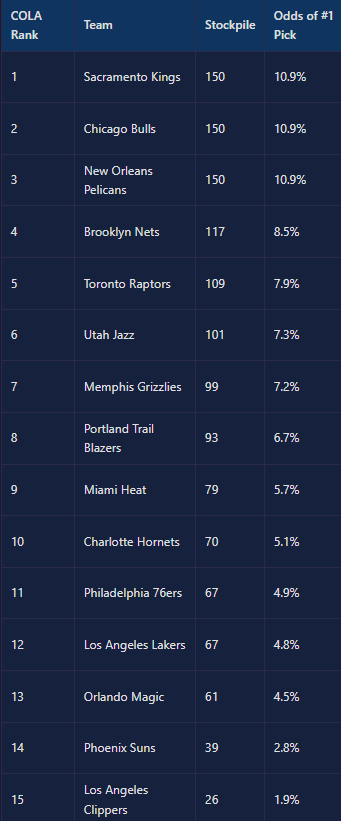
2025 NBA Lottery Odds based on Capped COLA
(Table generated by Kaushik Rajan’s COLA Explorer)